House Chores are easier while listening to stories
Your blog post
Blog post description.
6/17/20269 min read
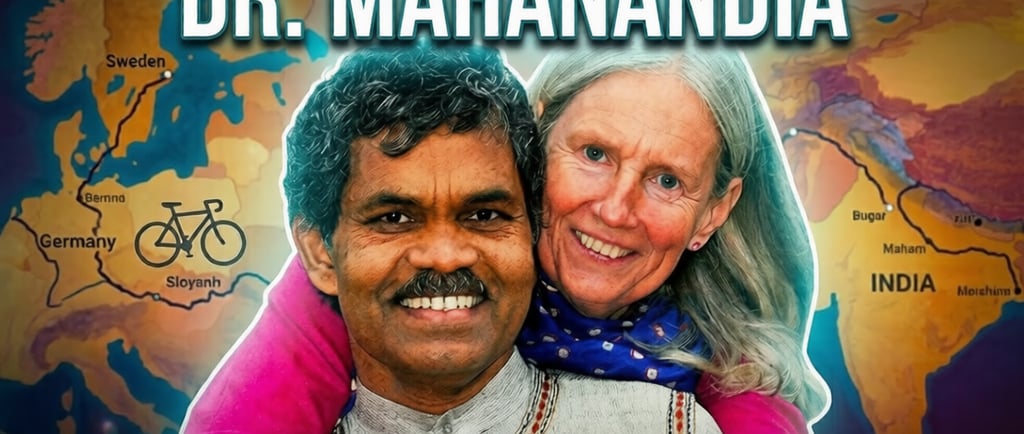
PK Mahanandia... A volcano of hope erupts from a well of despair
Today, I am filming from one of Egypt's spectacular beaches. The air is refreshing and the atmosphere is relaxing. Today, I don't feel like narrating a scary story or a story about crime and mystery, as I usually do. Instead, this peaceful atmosphere reminds me of a true, romantic and inspiring story that brings hope and optimism from the depth of despair and deprivation. A young man full of ambition and hope cycled 6,000 km from India to Sweden... Yes, you heard right... 6,000 km by bicycle for love. His name is Dr. Pradyumna Kumar Mehannandia, or PK Mehannandia for short. Do you know who Dr. P.K. Mahanandya is? He is a Swedish artist of Indian origin who currently works as an art and culture advisor to the Swedish government. So what is his story?
Dr. P. K. Mahanandia was born in 1949 in the village of Kan-da-pada in the Ath-malik region of Angul district in the Indian state of Odisha. He belonged to a family of weavers. As a child, Mahanandia was bullied and mistreated at school because he belonged to the Dalit caste, known in India as the untouchables. To understand the caste system in India, we must first take a quick look at the Hindu religious references on which this system is based. I would like to point out that not everything presented on the channel necessarily represents the beliefs and opinions of the channel, and that this channel does not aim to spread a particular ideology. Rather, we are simply a window displaying scenes from around the world with its different cultures, customs, traditions, history and civilisations, so that we can understand, compare and expand our perceptions in a better and more realistic way.
Hindus believe in multiple gods, examples of which include but are not limited to Lord Vishnu, known as the preserver or protector of the universe, Lord Ganesha, known as the remover of obstacles and the god of beginnings, wisdom and good fortune. Lord Shiva is known as the destroyer or transformer. Goddess Lakshmi is the goddess of wealth, luck and prosperity, and the goddess Durga embodies protection, motherhood and the destruction of evil forces. She is famous for her victory over the demon Ma-hi-sha-sura. These are just a few examples, but what interests us is the god Brahma, known as the god of creation or the creator of the universe and all creatures. The Hindu caste system is divided into four main categories: Brahmins, K-sha-triyas, Vai-shyas and Shudras.
Many believe that four categories originated from Brahma, the god of creation in the Hindu religion. At the top of the social pyramid were the Brahmins, who were mostly teachers and intellectuals, and are believed to have descended from Brahma's head. Next came the K-sha-triyas, or warriors and rulers, who were believed to have descended from his arms. Third in rank were the Vai-shyas, or merchants, who were created from his thighs. At the bottom of the pyramid were the Shudras, who came from Brahma's feet and performed all the menial tasks. Outside this Hindu caste system were the Dalits, or outcasts.
However, historians say that until the 18th century, formal class distinctions were of limited importance to Indians, social identities were more fluid, and people could easily move from one class to another.
New research shows that British colonial rulers set strict boundaries and made castes a defining social feature of India when they used censuses to simplify the system, primarily to create a single society with a common law that was easier to administer.
We can say that the Indian caste system has its roots in the Hindu religion, but society did not pay much attention to it until the British occupation reinforced the idea. The Indian government is trying hard to combat this extremist ideology and establish rules that promote social justice.
Hinduism believes in reincarnation, whereby when a person dies, their body perishes and their soul is transferred to the body of a child who will be born to begin a new cycle of life, and if a person's deeds in this world were good, they will return in their next life to a higher caste.
Let us return to the child Mahanandia, who belonged to the Dalit or untouchable caste. The child suffered greatly from the mistreatment of his classmates, who refused to talk to him or even sit next to him. Dr. Mahandadia said in one of his interviews that the caste system in India is organised racism. At home, when I was a child, I didn't feel it, but when I went to school, I got to know Hindus. There, I felt that I was not like them. It's like a skyscraper without an elevator. You are born on one floor and you die on the same floor. One day, the child Mahandaya came home from school crying and complaining to his mother about the mistreatment he was receiving at school. His classmates were constantly bullying him, refusing to sit next to him, and no one wanted to be his friend. His mother smiled and patted him with a mother's tenderness and compassion, then took out a palm tree leaf on which a prophecy was written by the village fortune teller. What was the fortune teller's prophecy? We will find out in the next episode. So we have reached the end of part 1 of our story for today. If you enjoyed the story, please support us by subscribing to the channel and activating the notification bell to receive the latest updates. See you soon. Bye bye.
@@@@@@@@@@@@@@@@@@@@@@@@@@@@@@@@@@@
In the previous episode we spoke about the child Mahandia. His upbringing, his life, and the caste he belongs to, called Dalits or the untouchables. We also explained who the Dalits are and the social oppression they face. We also spoke about the village fortune teller's prophecy about Mahandia's future, and now we will get to know what the prophecy predicted.
Dr. P. K. Mahandadia says:
My passport states that I was born on 5 December 1951, but later I discovered that I was actually born two years after the independence, in 1949. In India, it is common for parents to call a fortune teller when a new child is born. According to the prophecy, my wife and I were not meant to have an arranged marriage like many people in India. My parents were also told that my wife would be from a distant land and born under the sign of Taurus, and that she would be the owner of a forest or garden, and she would be a musician who played the flute. I strongly believed in the prophecy and now know that everything is planned on this planet.
Mahanandia attended Ma-hen-dra Secondary School in Athmalik and then enrolled at Visva-Bharati University to study art. Although he was accepted into the art college, he was unable to pay the tuition fees due to extreme poverty and was forced to return to his village. He later enrolled at the Government College of Arts and Crafts in Kha-liqot, Odisha, and then transferred to the College of Arts in Delhi in 1971.
While studying at the Delhi College of Arts, he became famous in the field of portrait painting by painting a portrait (pronounce the letter ‘t’) of Indira Gandhi. He asked permission from the authorities to sit under the fountain in Connaught Place, also known as Rajiv Chowk, one of the main financial, commercial and business centres in New Delhi, to paint portraits. It was here that he met Charlotte (sh) von Schie-dewen on 17 December 1975. She was a student in London and had driven a van for 22 days to India, just to visit Mahanandia and have her portrait painted after hearing about him.
Despite PK Mehanda's brilliance in painting and arts, she did not like the painting he did of her twice and asked him to come back and paint her again. Mehanda says, "There was an inner voice telling me that she was the one. During our first meeting, we were drawn to each other like magnets. It was love at first sight,‘ PK told the BBC.
He began asking Charlotte questions such as, ’Do you like music?‘ and ’Are you a Taurus?" These questions surprised Charlotte and increased her admiration for Mahanandia, and she could not refuse his invitation to have tea with him. Their relationship grew stronger and they travelled together. They visited the famous Konark Temple in PK's village in Orissa, and fell in love during this time.
Mahanandia says, "That was the moment she kissed me at the Sun Temple, when I said, ‘Oh my God, now I can touch the sky!’
A few days after they met, the couple travelled to PK's village in Orissa, eastern India, to meet his family and get married. Despite the death of his mother, PK's father gave them his full blessing. They were married according to Indian tradition. Charlotte had to return to Sweden to continue her studies. She asked Mahanandia to accompany her, but he had to finish his studies first, so he promised to join her later. Mahanandia began planning something that seemed impossible: a 6,000- or 7,000-kilometre overland journey to join Charlotte in Sweden.
Mahanandia did not have the money for a ticket to Sweden, but this did not stand in the way of love. He realised that Charlotte was his soul mate and that he could not live without her. Mahanandia sold all his possessions, bought a bicycle and decided to cycle from India to Sweden.
He bought a women's Rally bike because it was half the price of men’s bike. Then he set off with his passport, an extra pair of trousers, a sleeping bag, a windbreaker, and $80 sewn into his clothes. On the first night, he slept in a rice field and got a little wet. He continued his journey through Pakistan, Afghanistan, and Iran.
He covered about 44 kilometres (27 miles) every day on his bicycle, supporting himself by drawing pictures of people he met along the way, who gave him money, food, and shelter.
Mahanandia talks about the good he did for people and how that good came back to him. He talks about helping a German girl who was seriously injured in a car accident in Afghanistan and lost her teeth; later, we learn how hid good deeds came back to him. At a time when travel visas were not an obstacle and moving between countries was not as difficult as it is today, Mahandadia was able to enter Pakistan by drawing pictures for the border guards, and he mitigated the difficulty of his expired entry visa by drawing a picture of a senior government official.
Mahanandia believes that he was an inspiration to some. For example, In Herat Province in Afghanistan, which was under Russian rule at the time, he met an artist who admired Mahanandia's resilience (ree-zil-yins) and determination and who was also a painter. He told Mahanandia that he loved an adult student and wanted to marry her, but according to customs and traditions, he would be killed if he did so. Mahanandia encouraged him to challenge unjust traditions, and to follow his heart.‘ Later, PK discovered that the couple had travelled to Russia after the Russians left Afghanistan, where they had successful careers and a happy marriage. ’I was very moved when I realised that I might have given them some inspiration." (in-spee-ration) He said.
PK got rid of his old bike and bought a less shabby one. He was slowly but surely getting closer to his goal, supported by his new friends and the regular letters Charlotte sent him. Were there any doubts? He says: ‘During the trip, I had doubts that I would die and never be able to meet Charlotte.’ "But I knew that she was my beloved and my soul mate, and that we were meant to be for each other. I was certain that even if I didn't meet her in this life, I would surely meet her in the next life after death. Back to the German girl whom Mahanandia helped. Do you remember her? Her name is Leneya. This girl repaid Mahanandia's kindness when she sent him a train ticket to Vienna after she returned safely to Germany. Later, a gallery owner in the city, who was impressed by his story and talent as an artist, gave him tickets to Copenhagen and from there to Gothenburg. (h is silent)
About 16 months after their separation as newlyweds, PK and Charlotte met again outside the Salvation Army youth hostel in the city. It was a very emotional moment. Overcome with excitement and exhaustion,( iɡˈ-zôs-CH(ə)n)
PK began to cry. Charlotte took him for a walk in the local park, where they sat among the flowers and drank coffee.
“My parents’ acceptance of our life together was a big step,” Charlotte says. “My mother was cautious at first, and my father wasn’t a man of many words, but I had a strong will and a firm belief that this would work.”
Soon, the whole family moved to a farm and lived a more communal life. Charlotte says, “We were a more connected family, like families in India. That’s rare in Sweden, so I think we were a bit strange.”
They never considered returning to India to live there. They were certain that PK’s emerging political activism would have put them in danger. “I really fled India,” says PK.
They established a scholarship for children in PK's village, and since then they have spent most of their time involved in various charitable projects in the area.
Mahanandia and Charlotte currently live in Sweden and have two children, now adults, named Siddarth and Emily. Dr. Mahanandia works as an artist and as an arts and culture advisor to the Swedish government. His paintings have been exhibited (h is silent) in major cities around the world and appeared on UNICEF greeting cards. On 4 January 2012, he received an honorary (h is silent) doctorate from the University of Uttar Pradesh Culture (UUC) in Bhopal, Odisha, his hometown in India. The government of Odisha in India also appointed him as Odisha's cultural ambassador to Sweden.
Dr. P.K. Mahanandia and Charlotte say of their children, "They are well aware of the spiritual bond that unites us, and that we will never be separated. This is an important message for everyone. We humans differentiate ourselves a lot, but we all come from the same source." We wish Dr. Mahanandya and his wife continued happiness and prosperity, and we wish all couples the best in life.
So we have now reached the end of our episode for today. If you liked the story, please don't forget to support us by subscribing to the channel and activating the notification bell. Thank you and bye bye.
A Narrator's Ride
Follow Us!
Contact
hello@narratorsride.com
© 2026. All rights reserved.
